Thailand Flags: Sizes, Materials and Etiquette for Suppliers
2026年9月28日
Vietnam Flag Specifications: Sizes, Grommets, Heading and Fabric
2026年10月1日
If you are sourcing flags for markets in Southeast Asia, the climate is not a background detail — it is the main engineering constraint. A flag that looks crisp in a temperate showroom can look tired after a few weeks on a rooftop in Bangkok, Manila or Jakarta. Heat, year-round UV, high humidity, salt air and monsoon wind attack flags from several directions at once, and each of those forces pushes your fabric and ink choices in a slightly different direction.
This guide walks through the practical trade-offs we discuss with importers, distributors and promotional product buyers when they are specifying flags for tropical end markets.
Why Tropical Conditions Stress Flags Differently
- UV intensity: Strong, consistent sunlight breaks down dye molecules and degrades many synthetic fibers over time. Fading usually shows first on reds, then blues, while yellows and whites hold longer.
- Humidity and heat: Damp fabric stored warm is where mildew develops. Cellulose-based fibers such as cotton are the most vulnerable.
- Frequent wet-dry cycles: Rain, then rapid drying, then rain again. This cycling works on stitching, coatings and ink films.
- Salt-laden air: Coastal markets corrode plain steel grommets and hardware quickly, leaving rust stains on the fabric.
- Wind and monsoon gusts: The fly end — the loose edge opposite the flagpole — takes the most punishment. Almost every failed flag starts tearing there.
Fabric Options and Where Each One Fits
Spun Polyester
Spun polyester uses shorter, textured yarns that give a matte, traditional flag appearance. It handles UV well, holds dye-sublimated colour cleanly, and has enough body to hang properly on a pole. For permanent outdoor installations in tropical cities, this is the option most buyers come back to.
Knitted Polyester Mesh
Mesh is an open knit that lets wind pass through instead of fighting it. That single property makes it a strong choice for beachfront properties, golf courses, roadside advertising and any exposed position where monsoon gusts are expected. The trade-off is lower colour saturation, because the ink coverage is interrupted by the open structure. Designs with large solid areas and bold shapes read better on mesh than fine detail does.
Lightweight Filament Polyester (roughly 70D–110D)
Lighter weights fly in a gentle breeze, which is useful for indoor display, retail and promotional giveaways where the flag is often hung without much airflow. They are less abrasion-resistant than heavier spun fabrics, so they suit shorter-term or sheltered use.
Nylon
Nylon is strong for its weight and takes bright colours well. However, it absorbs moisture more readily than polyester and needs to be thoroughly dry before packing. In humid tropical storage, that is an operational risk worth planning for. Nylon is often a better fit for indoor or ceremonial use than for permanent outdoor exposure.
What to Avoid for Outdoor Tropical Use
- Cotton and cotton blends: Comfortable to handle, but mildew-prone in humid climates and slower to dry.
- Very light non-woven promotional flags: Fine as a short-lived giveaway, poor as an outdoor installation.
- Rigid PVC and vinyl: Excellent for banners and rigid signage, not for flags that need to fly.
| Fabric | Hand & Appearance | Tropical Suitability | Typical Use |
|---|---|---|---|
| Spun polyester | Matte, traditional, good body | Well-suited to permanent outdoor exposure | National flags, institutional, hotel flags |
| Knitted polyester mesh | Open weave, lower colour density | Handles wind and gusts well | Beachfront, roadside, golf, exposed sites |
| Lightweight filament polyester | Light, flies easily | Good for sheltered or short-term use | Promotional, retail, indoor display |
| Nylon | Bright, smooth, strong for weight | Needs careful drying and storage | Indoor, ceremonial, light outdoor |
Ink Systems: Where Colour Actually Lives
Dye Sublimation
Dye sublimation is the default for polyester flags, and for tropical markets it is usually the sensible starting point. The disperse dye is transferred as a gas and bonds into the fibre itself rather than sitting on the surface. Because the colour is inside the yarn, the print does not crack when the fabric flexes in wind, and it does not develop the stiff, blocked feel that heavy surface coatings can.
Two practical notes for hot climates: the fabric still needs UV-stable base material and quality disperse dyes, and dark, saturated colour builds use more ink, which slightly changes the hand of the finished flag. Ask your supplier how the artwork will be profiled.
Screen Printing
Screen printing remains efficient for high-volume designs with a limited number of solid spot colours and sharp edges. When specifying screen-printed flags for the tropics, the ink system matters more than the printing method. Plastisol-type inks can soften in high heat and cause “blocking” — the print sticking to itself when the flag is folded and stacked. Confirm with your supplier that the ink is formulated for outdoor textile use and ask for a folded sample so you can check for blocking before you commit to a production run.
Digital UV and Latex Printing
These systems are widely used for banners, backdrops and rigid signage, where the substrate is PVC or coated banner material. They are less common for flags that need to fly, since flexibility and drape matter more than surface print sharpness.
Colour Matching in Tropical Light
Colours read differently under bright, warm daylight than under showroom lighting. If brand colour accuracy matters, review the proof under natural daylight and consider whether the design will be viewed mostly in strong sun or in shade.
Finishing Details That Decide Service Life
- Reinforced fly end: A double-stitched, sometimes folded and reinforced fly hem is the single most useful upgrade for windy sites.
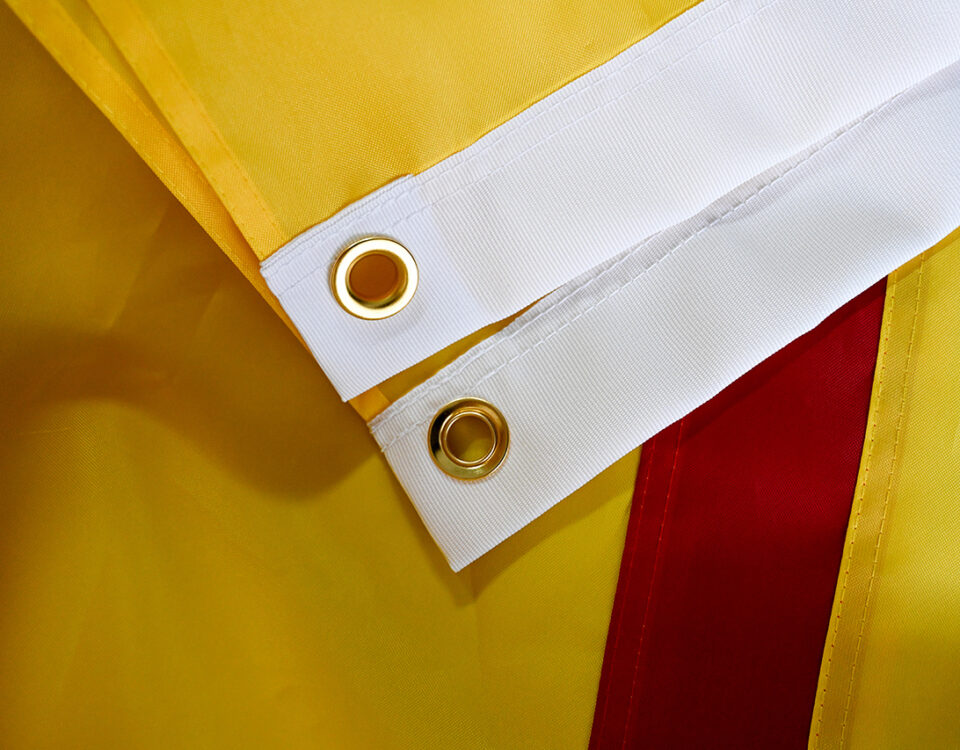
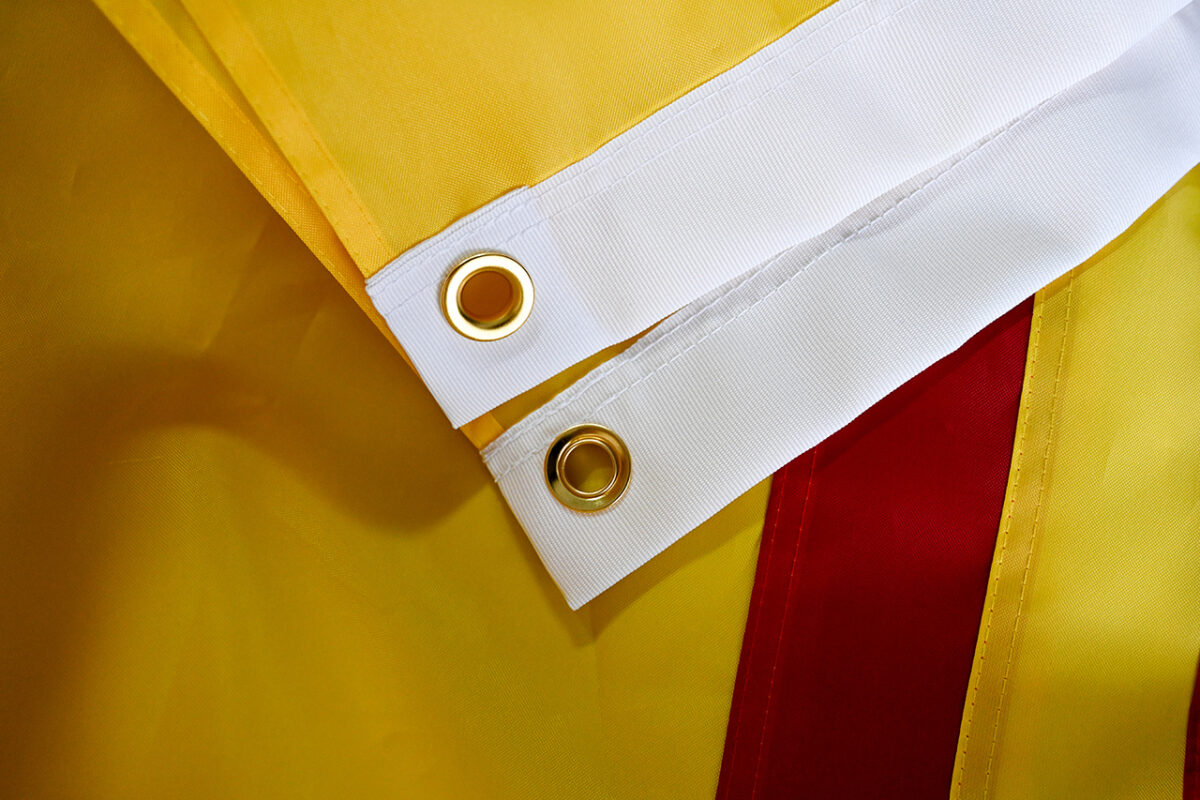
- Hardware metal: Specify brass or stainless steel grommets and rings for coastal markets. Plain steel rusts and stains.
- Thread: Use UV-stable polyester thread, not cotton, and check stitch density. Dense stitching resists tearing better than long, sparse stitches.
- Header tape and rope: For mast-mounted flags, a strong header tape with rope and toggle distributes load better than grommets alone.
- Corner reinforcement: Extra patches at the hoist corners help where the flag meets the pole hardware.
Packing, Storage and Shipping into Humid Markets
Fabric performance is only half the story — how the goods travel and sit in a warehouse decides a lot too.
- Ensure flags are fully dry before folding and bagging. Residual moisture is what feeds mildew.
- Include desiccant packs in export cartons, particularly for sea freight through humid routes.
- Specify moisture-resistant inner bags so cartons that sit in a non-airconditioned warehouse are protected.
- Store in a ventilated area rather than against a cold concrete wall, which encourages condensation.
- Label each bundle with fabric specification, ink system and finishing details so reorders match the original.
Matching Fabric to End Use
| End Use | Suggested Fabric | Suggested Print | Finishing Focus |
|---|---|---|---|
| Permanent outdoor, inland city | Spun polyester | Dye sublimation | Reinforced fly end, brass grommets |
| Coastal or exposed, high wind | Knitted polyester mesh | Dye sublimation | Stainless hardware, heavy fly reinforcement |
| Promotional giveaway | Lightweight polyester | Dye sublimation | Simple hem, low-cost hardware |
| Indoor retail and showroom | Spun polyester or display satin | Dye sublimation | Clean edge, display pole fittings |
| Large solid-colour runs | Spun polyester | Screen printing | Blocking check, outdoor-grade ink |
Questions to Put to Your Supplier
- What fabric construction and weight are you proposing, and why does it suit my end use?
- Which ink system will be used, and is it specified for outdoor textile applications?
- How is the fly end reinforced, and how dense
Browse the full range: https://flagpartner.com/shop/
Email: flagswin@flag-win.vip
WhatsApp: +86 13031678795
Facebook: https://www.facebook.com/StarFlagFactory/
Alibaba.com: https://wfqyflag.en.alibaba.com/