Ramadan Banners and Eid Bunting: What Sells in Muslim-Majority Markets
2026年10月10日
Printed Tablecloths for Hotels, Markets and Events: A Buyer’s Guide for Southeast Asia
2026年10月12日
Why Vietnam Flag Specifications Matter for Southeast Asian Buyers
Vietnam flags sell steadily across Southeast Asia — for government offices, schools, trade events, retail chains, sports occasions and promotional giveaways. Buyers who order the standard red-and-yellow design often assume it is a simple item to source, then discover that small differences in size ratio, heading style and fabric weight decide whether the shipment sells through or sits in the warehouse.
This guide breaks down the practical Vietnam flag specifications that matter when you place a purchase order: the design proportions, the size range, the heading and grommet options, and the fabric choices. Whether you are a distributor stocking retail SKUs or a promotional products buyer sourcing a custom run, this is the information you need on the spec sheet.
The Design Basics of the cờ đỏ sao vàng Flag
The Vietnamese national flag, known locally as the cờ đỏ sao vàng flag, is a red field with a single five-pointed golden-yellow star centred on it. The star is oriented with one point facing upward, and the design is symmetrical so that the flag reads correctly from both sides.
Two production points follow from the design:
- Proportion. The recognised proportion for the national flag is 2:3 (height to width). Most export orders are produced at 2:3, but retail markets sometimes request 1:2 or a squarer 3:5 for decorative framing. Confirm the ratio in writing, because a flag cut to the wrong ratio looks noticeably off next to a correctly sized one.
- Star placement and size. The star should be geometrically centred, with equal margins to the top and bottom edges as well as the left and right edges. Ask your supplier for a pre-production digital proof showing the layout grid before bulk printing starts.
Common Vietnam Flag Sizes
Below is a practical size chart covering most orders, all at the standard 2:3 ratio. Custom dimensions are usually possible with no die cost, since printed flags are cut from a printed roll.
| Size (cm) | Typical use | Suggested fabric weight |
|---|---|---|
| 20 × 30 | Desk stand, car dashboard, hand wave | 70–90 gsm |
| 30 × 45 | Handheld parade, school activities | 70–90 gsm |
| 40 × 60 | Small pole, retail multipack | 70–90 gsm |
| 60 × 90 | Home and shopfront pole, promo item | 100–115 gsm |
| 80 × 120 | Office and small outdoor pole | 100–115 gsm |
| 90 × 150 | The most common export size | 100–115 gsm |
| 120 × 180 | Government building, large pole | 115–135 gsm |
| 150 × 225 | Tall flagpole, public square | 130–160 gsm |
| 160 × 240 | Large outdoor installation | 130–160 gsm or mesh |
For hand-waving and promotional flags, lighter cloth keeps the flag flying in low wind and reduces shipping cost per unit. For large outdoor flags, heavier cloth and a reinforced fly end extend service life under sustained wind load.
Fabric Options for Vietnam Flags
Fabric choice affects how the red field renders, how quickly the flag dries, and how it behaves in wind. The main options from a Vietnam flag supplier in China are:
- Polyester knit, 100–115 gsm. The workhorse for printed national flags. Takes dye sublimation well, dries quickly, and holds its shape on a pole. Suitable for the full 60 × 90 cm to 120 × 180 cm range.
- Lightweight polyester, 70–90 gsm. Used for small handheld and desk flags where light weight and low cost matter more than durability in wind.
- Heavyweight polyester, 130–160 gsm. Woven or warp-knit constructions for large outdoor flags that need more body and resistance to edge fraying.
- Nylon. Lighter than polyester for the same area, flies in very light breezes and packs down small — a good fit for marine and travel use. It is generally softer and less crisp on the pole.
- Cotton bunting or satin. Reserved for ceremonial and indoor presentation flags, where a traditional look matters more than weather resistance.
- Mesh. Open-weave fabric for very large flags in high-wind locations. It lets air through, which reduces stress on the pole and the heading.
Colour matching is worth stating explicitly on the order. The red field and the golden-yellow star should be matched to an approved reference swatch or Pantone target, and that same reference should be attached to the purchase order so repeat orders stay consistent.
Heading Styles: How the Flag Attaches
The heading is the reinforced strip along the hoist edge. It is the part that carries all the load, so it deserves as much attention as the printed artwork.
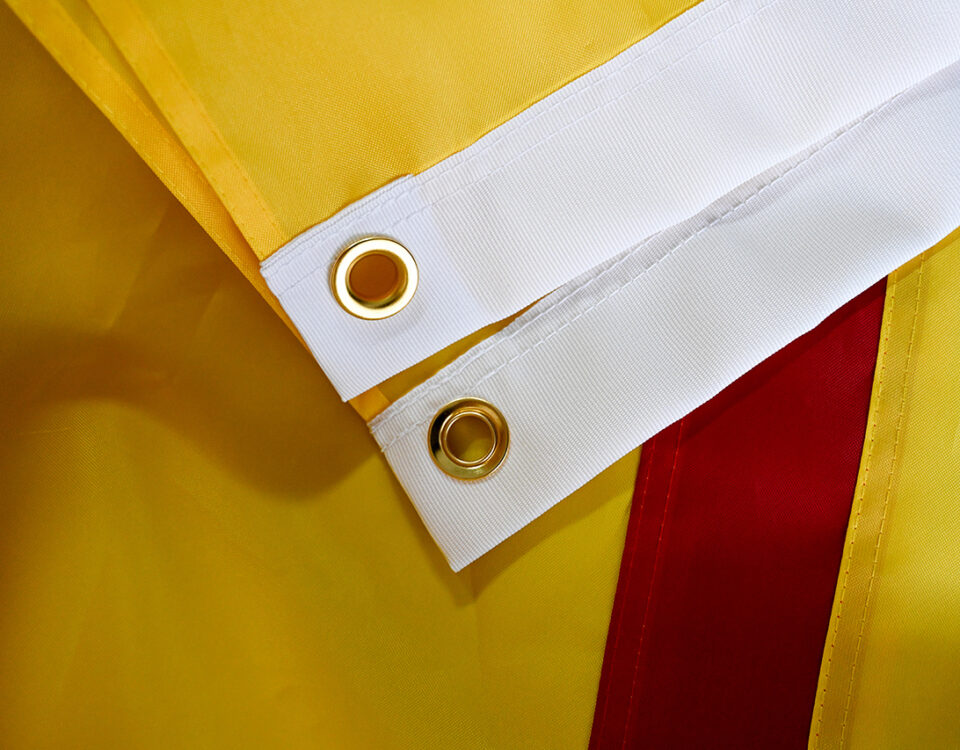
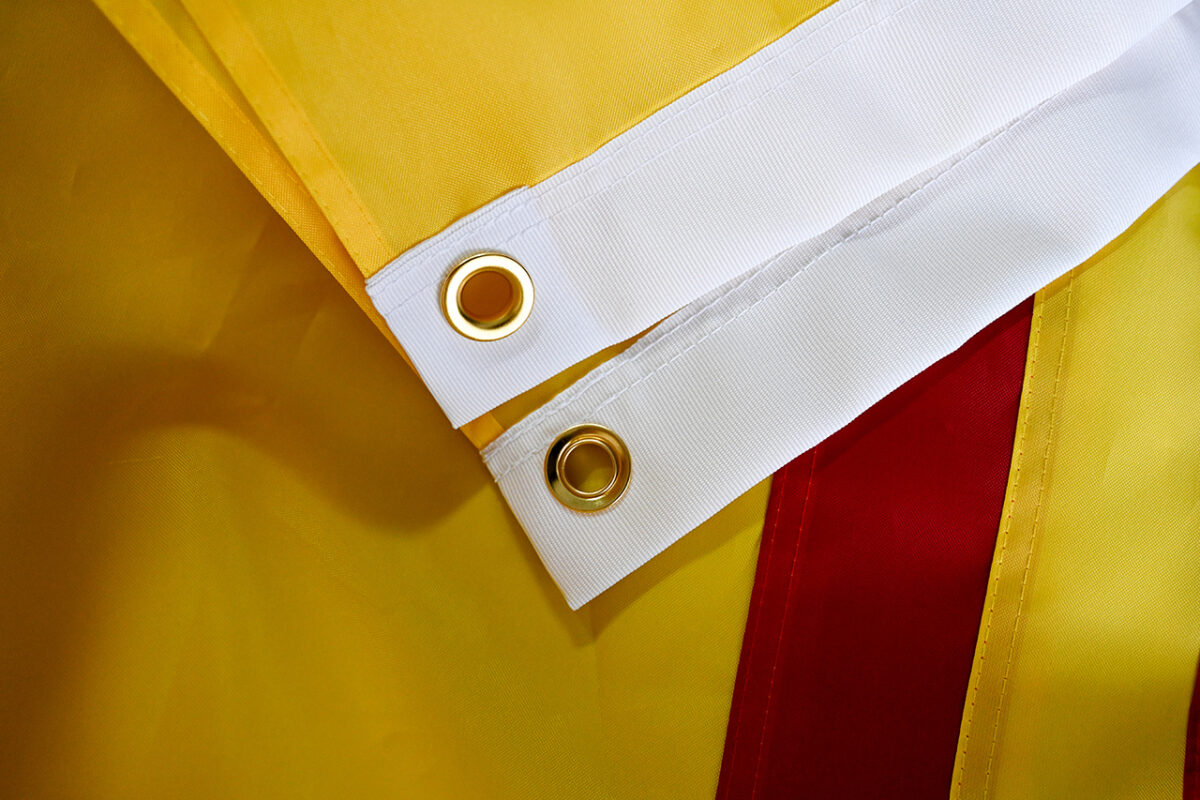
- Canvas heading with grommets. A poly-cotton tape, usually 3.8–5 cm wide, folded over the hoist edge and stitched top and bottom. The default for most export orders because it works with ropes, ties and hooks.
- Pole sleeve (hoist sleeve). A fabric tunnel, typically 5–8 cm wide, that slides over a pole or staff. Common for hand flags, desk sets and indoor display.
- Rope and toggle. A halyard rope sewn into the heading with a wooden or plastic toggle at one end and a loop at the other. Practical for tall flagpoles where the flag is raised and lowered regularly.
- D-ring or snap-hook heading. Metal rings sewn into the heading for quick attachment to a halyard. Often requested for institutional and ceremonial use.
Specify the heading colour as well. White is standard, but buyers sometimes request red or navy heading for a cleaner look against the flag edge.
Grommet Specifications
Grommets are small details that generate a disproportionate number of quality complaints, so pin them down on the spec sheet.
- Material. Brass is the usual choice for a warm tone and good corrosion resistance. Stainless steel is preferred for coastal and marine environments. Both are available with a rolled or flat rim.
- Inner diameter. 10 mm and 12 mm cover most orders. Larger 15–20 mm grommets are used on heavy outdoor flags where thicker rope or bungee is required.
- Quantity and placement. Standard is one grommet at each corner of the heading. As the flag gets larger, add one in the centre, then two more at the quarter points, so the load is spread evenly and the heading does not sag.
- Reinforcement. Corner patches or a doubled heading at each grommet position help prevent the fabric from tearing away from the hardware. Worth requesting on anything above 90 × 150 cm.
Printing and Finishing Details
Most Vietnam flags are produced either by dye sublimation printing or by screen printing. Dye sublimation handles fine detail and gradient-free solids well and is economical from small to mid volumes. Screen printing uses spot colours mixed to a reference and is efficient for high-volume runs of a two-colour design.
For a more formal look, the star can be sewn or appliquéd rather than printed, with the red field either printed or dyed. This is typically reserved for ceremonial and government-grade flags.
Finishing details to confirm on any order of Vietnam flag specifications:
- Hem width, usually 1–2 cm on the top, bottom and fly edges
- Double-stitched or multi-row stitching along the fly end, which takes the most wind stress
- Thread colour matched to the fabric, or contrast white where specified
- Reverse side treatment — mirrored print, or a two-ply double-reverse construction that reads correctly from both sides
Packaging and
Browse the full range: https://flagpartner.com/shop/
Email: flagswin@flag-win.vip
WhatsApp: +86 13031678795
Facebook: https://www.facebook.com/StarFlagFactory/
Alibaba.com: https://wfqyflag.en.alibaba.com/