Ramadan Banners and Eid Bunting: What Sells in Muslim-Majority Markets
2026年10月4日Malaysia has thirteen states and three federal territories, and each one flies a flag of its own alongside the national Jalur Gemilang. For importers, distributors and promotional product buyers across Southeast Asia, that adds up to a compact but reliable product family: fixed designs, repeatable orders, and steady demand from schools, government offices, sports events, cultural associations and retail souvenir channels.
This guide covers the practical points that matter when you source Malaysian state flags — what to stock, which fabrics and finishes suit which end use, how to handle artwork, and what to confirm with a manufacturer before the first bulk order.
Who Buys Malaysian State Flags, and When
Demand for state flags is spread across the year rather than concentrated in one season. Typical buyer groups include:
- Government and district offices — state and federal territory flags for official buildings, ceremonies and public events.
- Schools and universities — assembly displays, sports days, uniformed groups and state-level competitions.
- Sports and cultural events — state contingents, marching bands, cultural festivals and community celebrations.
- Retail and souvenir shops — small hand-wavers, desk flags and gift-packed sets for tourists and locals alike.
- Corporate and promotional buyers — dealer networks, CSR programmes and regional offices that want to reflect the state they operate in.
Because the artwork is fixed, these are excellent catalogue lines: once a design is approved, reorders are straightforward and inventory planning is predictable.
The Product Range You Are Actually Ordering
A complete Malaysian state flag programme usually includes:
- The thirteen state flags — Johor, Kedah, Kelantan, Melaka, Negeri Sembilan, Pahang, Penang, Perak, Perlis, Sabah, Sarawak, Selangor and Terengganu.
- The three federal territory flags — Kuala Lumpur, Labuan and Putrajaya.
- The national flag as a companion SKU, plus state bunting, table flags and pennants.
State designs combine crescents, stars, bands, emblems and crests in specific proportions. Treat official references as the source of truth and avoid redrawing elements casually — a slightly wrong crescent or crest is immediately noticeable to local buyers and can cost you a repeat order.
Matching Fabric to End Use
The right fabric depends on where the flag will be flown, for how long, and at what price point it needs to retail.
| Fabric | Typical use | Notes for buyers |
|---|---|---|
| Lightweight knitted polyester (around 100–115 gsm) | General outdoor display, volume orders, retail packs | Light, economical, prints well; a practical default for most catalogue lines. |
| Heavier spun or woven polyester | Ceremonial, indoor and institutional use | Denser hand and better drape; suits buyers who want a more substantial feel. |
| Mesh polyester | Poles, facades and exposed sites | Open weave lets air pass through, which reduces strain on poles and fixings. |
| Polyester satin | Indoor displays, retail and gift packaging | Glossy surface and clean print detail; good for presentation-focused SKUs. |
Print methods
- Dye sublimation — the standard for state flags, since it handles the fine detail in crescents, stars and crests and allows full-colour artwork without extra setup.
- Screen printing — cost-effective for high-volume runs with a limited number of spot colours.
- Digital transfer — useful for short runs, samples and small desk flags where setup cost needs to stay low.
Sizes, Finishing and Hardware
Most orders settle into a handful of standard formats:
- 90 × 150 cm — the common outdoor and flagpole size.
- 60 × 90 cm and 45 × 75 cm — smaller poles, indoor stands and window displays.
- 30 × 45 cm and 20 × 30 cm — plastic-stick hand wavers for events and giveaways.
- 10 × 15 cm — desk flags with a base, popular in gift and corporate sets.
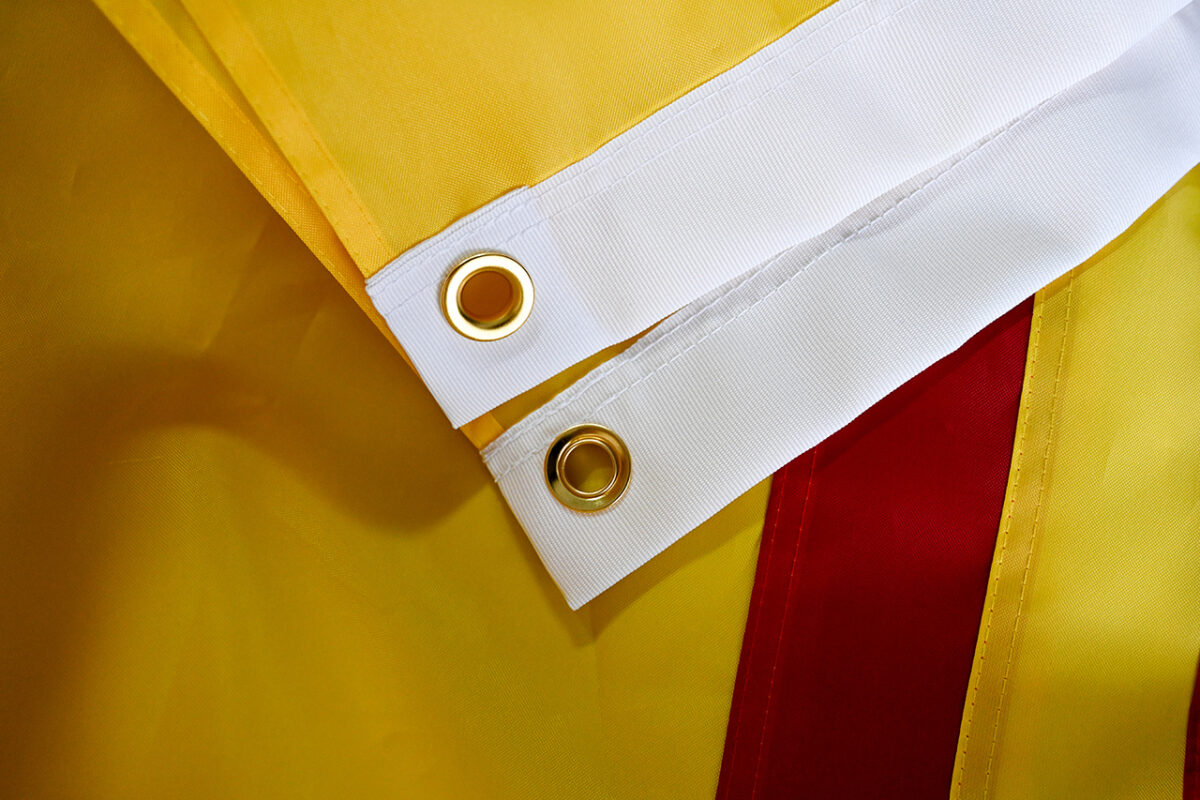
Finishing is where resellers often find their margin or lose it. Options include a header tape with two brass eyelets, rope and toggle, a pole sleeve, or D-rings. Reinforced fly-end and corner stitching helps with the stress points that see the most movement. For flags that must read correctly from both sides, a three-layer construction with an inner liner is worth quoting as a premium option.
Packaging also matters: polybag only for wholesale, or polybag plus header card, barcode and hang tag if the product is going onto a retail rack.
Artwork, Colour and Approvals
Ask for vector artwork in AI, EPS or PDF. Raster files cause soft edges in fine emblem detail, and once a mistake is printed across a bulk order it cannot be corrected.
Confirm how colours will be handled. Where spot accuracy matters, provide Pantone references alongside your files. Where the artwork is full colour, CMYK is usually the practical route.
Before production, request a digital proof and, for new designs, a physical pre-production sample. Keep a master file for each of the Malaysian state flags in your range so reorders match the first shipment without another round of artwork review.
Cultural and Tender Considerations
State and federal territory flags carry
Browse the full range: https://flagpartner.com/shop/
Email: flagswin@flag-win.vip
WhatsApp: +86 13031678795
Facebook: https://www.facebook.com/StarFlagFactory/
Alibaba.com: https://wfqyflag.en.alibaba.com/