
Buying Indonesian Flags for Government, School and Office Tenders
2026年9月24日Singapore National Day Flags and Bunting: A Seasonal Buying Calendar
2026年9月26日Why Flag Sizing Is Not a One-Size Decision in Southeast Asia
Buyers sourcing flags for Southeast Asian markets quickly discover that the global default size does not always fit local expectations. A 90 x 150 cm flag is the standard reference point almost everywhere, but the region has its own patterns: metric measurements dominate, national flag proportions vary from country to country, and demand swings hard around independence days, election cycles and religious festivals.
This guide covers the sizes importers, distributors and promotional product buyers typically order, and the details worth clarifying before placing a production run with your manufacturer.
Start With Proportions, Not Just Measurements
Southeast Asian national flags fall into two main proportion families: 2:3 and 1:2. If a buyer orders a 90 x 150 cm flag for a 2:3 country, the flag will still be recognised and used, but it is slightly shorter in relation to its width than the official specification. For ceremonial, government and flag-protocol use, buyers usually request a size that matches the ratio exactly.
| Market | Official flag ratio | Sizes that match cleanly |
|---|---|---|
| Indonesia | 2:3 | 60×90 cm, 100×150 cm, 120×180 cm |
| Singapore | 2:3 | 60×90 cm, 100×150 cm, 120×180 cm |
| Thailand | 2:3 | 60×90 cm, 100×150 cm, 120×180 cm |
| Vietnam | 2:3 | 60×90 cm, 100×150 cm, 120×180 cm |
| Cambodia | 2:3 | 60×90 cm, 100×150 cm, 120×180 cm |
| Laos | 2:3 | 60×90 cm, 100×150 cm, 120×180 cm |
| Myanmar | 2:3 | 60×90 cm, 100×150 cm, 120×180 cm |
| Malaysia | 1:2 | 60×120 cm, 90×180 cm, 100×200 cm |
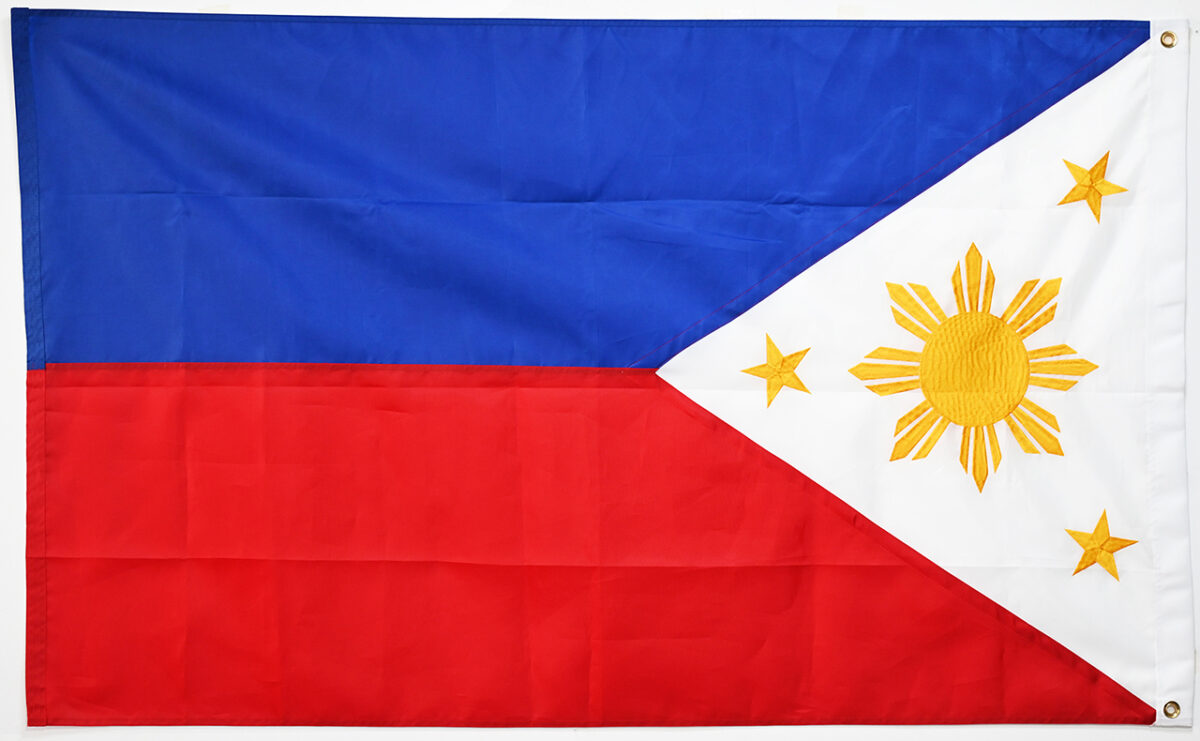
| Philippines | 1:2 | 60×120 cm, 90×180 cm, 150×300 cm |
| Brunei | 1:2 | 60×120 cm, 90×180 cm |
| Timor-Leste | 1:2 | 60×120 cm, 90×180 cm |
In practice, decorative and promotional orders still lean heavily on 90 x 150 cm even in 1:2 markets, because that size is what retail shelves and event organisers expect. Where protocol matters — government buildings, schools, military and ceremonial display — buyers move to the ratio-correct sizes in the right-hand column.
The Metric Workhorses
90 x 150 cm (roughly 3 x 5 ft)
The default export size. It suits most standard flagpoles between 4 and 6 metres, and it is the size most distributors stock as a core SKU for general retail.
60 x 90 cm (roughly 2 x 3 ft)
Exact 2:3 proportion, which makes it popular for Indonesian, Thai, Vietnamese, Singaporean and Myanmar flags where accuracy matters. It is also a common campaign and event size because it takes less pole height and packs efficiently.
100 x 150 cm and 120 x 180 cm
Both are exact 2:3 and are frequently specified for institutional, school and government supply. Buyers who want the visual weight of a 150 cm flag without compromising proportion choose the 100 x 150 cm.
150 x 225 cm and 200 x 300 cm
Large-format sizes for building facades, flagpole arrays, showrooms and broadcast backgrounds. Order volumes are lower but unit value is higher, and finishing quality becomes more visible at this scale.
Handheld and Parade Flags: The Highest-Volume Segment
Wave flags are where Southeast Asian buyers place their largest orders. Election periods, national day parades, school events and corporate promotions all generate bulk demand.
- 14 x 21 cm — small hand wave flag
Browse the full range: https://flagpartner.com/shop/
Email: flagswin@flag-win.vip
WhatsApp: +86 13031678795
Facebook: https://www.facebook.com/StarFlagFactory/
Alibaba.com: https://wfqyflag.en.alibaba.com/