
Sourcing Prayer Rugs: Materials, Sizes and Quality Checks for Importers
2026年9月23日Flag Size Conventions in Southeast Asia: What Wholesale Buyers Actually Order
2026年9月25日
Buying Indonesian Flags for Government, School and Office Tenders
For importers, distributors and promotional product buyers across Southeast Asia, the Indonesian flag is one of the most predictable repeat-purchase items in the textile category. Demand is driven by rules, rituals and calendars rather than fashion: government offices, schools and private companies are expected to display the Merah Putih, and ceremonial use peaks around Independence Day on 17 August and other national observances.
That predictability is good news for anyone bidding on tenders. What decides whether a bid succeeds is rarely the flag itself — it is whether the delivered goods match the specification exactly, batch after batch, and whether documentation and packaging survive scrutiny at the receiving end. This guide walks through the practical sourcing points that matter.
What Tender Documents Usually Specify
Public and institutional procurement in Indonesia typically lists the product under a set of measurable characteristics. When you read a tender for flags, look for these items:
- Country and design: Republic of Indonesia flag, horizontal red over white, national ratio of 2:3 unless stated otherwise
- Finished size: given in centimetres, usually as width × length along the hoist and fly
- Fabric type and weight: spun polyester, knitted polyester, nylon or satin, expressed in gsm
- Construction: hoist heading type, stitching pattern, reinforcement at fly and corners
- Attachment: rope and toggle, brass grommets, pole sleeve, or loops with D-rings
- Packing: individual poly bag, quantity per inner box and per export carton
- Delivery and documents: delivery point, packing list, invoice, and any local content or registration requirements
Some tenders also reference local content rules (TKDN) or require supply through a locally registered entity. Always read the commercial terms section of the tender before quoting — that is a commercial question rather than a manufacturing one, and it is worth confirming with the buyer early.
Commonly Requested Sizes
Buyers rarely order a single size. A tender for a provincial education office, for example, might mix classroom flags with larger ceremonial pieces. The table below covers the sizes most frequently requested by Indonesian institutional buyers.
| Finished size (cm) | Typical use | Fabric weight commonly paired |
|---|---|---|
| 200 × 300 | Outdoor flagpoles, field ceremonies | Heavier spun polyester |
| 120 × 180 | Large office, campus and courtyard poles | Spun or knitted polyester |
| 100 × 150 | Office halls, meeting rooms, stage backdrops | Knitted polyester |
| 90 × 135 | Indoor ceremonial use | Knitted polyester or satin |
| 60 × 90 | Classrooms, desk-mounted poles | Knitted polyester |
| 30 × 45 and smaller | Desk flags, vehicles, promotional giveaways | Lightweight polyester or satin |
Choosing the Right Fabric
Fabric choice drives cost, drape and how the flag behaves on a pole. There is no single correct answer, but there is a correct answer for each tender.
Spun polyester
A woven, matt-finish fabric with a denser hand. It hangs with weight, resists distortion better than lightweight knits, and is the usual choice for large outdoor flags. Print penetration on both sides is generally good, so the reverse side reads correctly enough for display purposes.
Knitted polyester
Lighter, softer and more economical. It flutters at low wind speeds, which suits smaller indoor flags and classroom sizes. Dye sublimation printing on knit gives a smooth, even field of colour, and the fabric is easy to fold and store.
Nylon and satin
Nylon is chosen for light weight and a slight sheen; satin is requested for indoor ceremonial and presentation flags where appearance on a stand matters more than wind performance. Both are usually ordered in smaller sizes.
Construction Details Buyers Notice
At the receiving end, quality is judged by the edges and corners. Specify these points clearly in your purchase order:
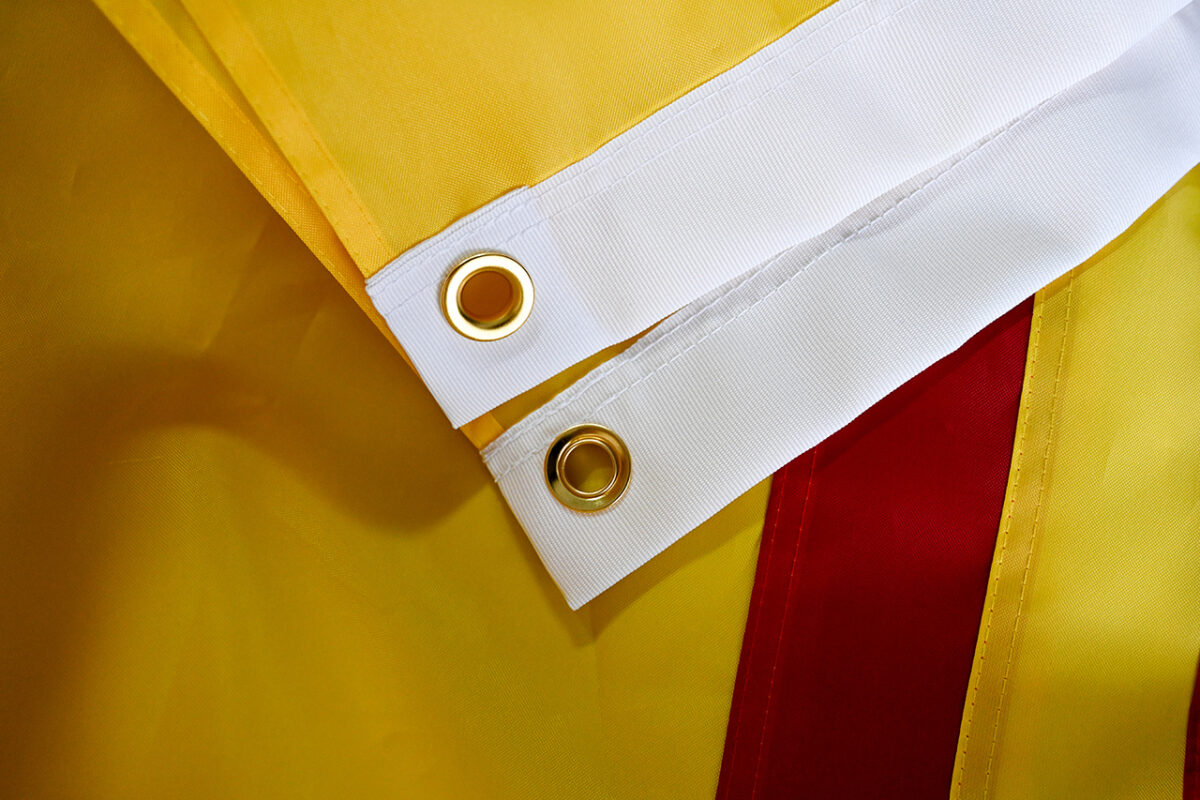
- Hoist heading: a white canvas or polyester heading, typically 4–6 cm wide, stitched with two or more rows
- Fly end: double-folded and reinforced with multiple rows of stitching to resist stress
- Corners: reinforced at the fly corners, where tearing usually starts
- Thread: colour-matched thread for the red and white fields, with a contrasting thread only where the tender permits it
- Attachment hardware: brass grommets (usually two, sometimes three on larger sizes), rope and toggle, or a pole sleeve with a bottom opening
Colour Consistency Across Batches
Red is the detail that gets flags rejected. A bright, saturated red in one shipment and a duller, orange-leaning red in the next is immediately visible when flags are raised side by side in a ceremony.
To avoid this, approve a physical reference sample before bulk production and keep it on file. Ask the manufacturer to produce the full order from the same dye lot or ink batch where possible, and to match subsequent reorders against the retained sample. Suppliers such as FlagPartner, a custom printed flags and textiles manufacturer in China, work from approved pre-production samples for exactly this reason — the sample becomes the contract.
Sampling, Lead Time and Order Flow
Institutional tenders usually require a sample or a sample photograph before award. A practical flow looks like this:
- Confirm size, fabric, attachment and packing specification
- Request a pre-production sample in the exact construction to be delivered
- Approve the sample in writing, retaining one piece and sending one to the buyer
- Place the bulk order against the approved sample
- Arrange inspection, packing and shipment
Lead time depends on quantity, fabric availability and finishing complexity, so build sample approval and production into the tender timeline rather than assuming stock. Where a tender has a fixed delivery date, ask the factory to confirm the schedule in writing before you bid.
Packing and Documentation for Institutional Delivery
Government and school deliveries are often unpacked by staff who are not familiar with the product. Clear packing helps:
- Individual poly bag per flag with a size and specification label
- Inner boxes that keep the quantity per box easy to count
- Export cartons with shipping marks matching the packing list
- Packing list, invoice and product specification sheet included with documents
- Optional barcode or asset labels if the buyer’s warehouse requires them
A Short Sourcing Checklist
- Confirm the 2:3 ratio and finished size in centimetres
- Match fabric type and weight to the tender wording
- Specify heading, stitching rows, corner reinforcement and hardware
- Approve a physical colour and construction sample
- Retain the sample for reorder matching
- Agree packing, labelling and carton marks in writing
- Check any local registration or content requirements before quoting
Tender-driven flag business rewards consistency more than creativity. If you can promise the same red, the same size and the same finishing in March as you delivered in August, you become the supplier procurement officers return to.
Browse the flag and textile products available at FlagPartner to review sizes, fabric options and finishing, or send your tender specification for a quotation.
Browse the full range: https://flagpartner.com/shop/
Email: flagswin@flag-win.vip
WhatsApp: +86 13031678795
Facebook: https://www.facebook.com/StarFlagFactory/
Alibaba.com: https://wfqyflag.en.alibaba.com/