
Malaysian State Flags: A Practical Sourcing Guide for Importers and Resellers
2026年10月22日
Malaysian State Flags: A Practical Guide for Importers and Resellers
2026年10月24日
Tender buyers rarely lose a contract on price alone. They lose it because a flag arrives in the wrong shade of red, with grommets in the wrong place, or with a specification sheet that does not match what was actually delivered. For bendera merah putih orders — the Indonesian national flag — the margin for error is smaller than for most promotional textiles, because the buyer is often a government office, a school, or a procurement unit that has to justify its decision in writing.
This guide walks through what matters when sourcing Indonesian flags wholesale for public-sector and institutional tenders: the specification baseline, the fabric and construction choices that actually affect the delivered product, and the paperwork that makes an offer easy to accept.
Start with the specification, not the price
Indonesia regulates its national flag. The flag is defined with a 2:3 width-to-length ratio, two equal horizontal bands of red over white, and a defined set of standard sizes. When a school, ministry, or state-owned enterprise writes a tender, the technical annex usually borrows from that framework — sometimes precisely, sometimes loosely.
Before quoting, ask the buyer for the annex and read it line by line. The three points that most often cause disputes are:
- Ratio. A 2:3 flag at 90 × 135 cm is standard; a 90 × 150 cm flag is a different ratio entirely and will not satisfy a specification written against the national standard.
- Size tolerances. Finished size is not cut size. Hemming and heading construction reduce the measurable field, so agree whether the tender refers to cut size or finished size.
- Colour reference. “Red and white” is not a specification. Agree on a physical swatch or a colour reference the supplier can match across production lots, and approve it in writing before bulk runs.
If the tender text is ambiguous, submit a clarification rather than assuming. A written answer from the procurement officer protects both sides.
Standard sizes institutional buyers typically request
The table below reflects the sizes that appear most often in Indonesian tender documents for offices, schools and public buildings. Treat it as a starting point for discussion, and confirm the current regulatory text and the buyer’s own annex before committing to a production plan.
| Typical use | Size (cm) | Common construction notes |
|---|---|---|
| Large building or field pole | 200 × 300 | Heavy heading, reinforced fly, rope and toggle or large grommets |
| School yard and office flagpole | 120 × 180 | Canvas heading with two brass grommets, or sleeve |
| Standard office pole | 90 × 135 | Canvas heading, double-stitched hems |
| Indoor pole, meeting room | 60 × 90 | Pole sleeve with optional cord and tassel |
| Desk flag and ceremony sets | 20 × 30, 30 × 45 | Small sleeve for a wooden or plastic stand |
Volume tenders frequently mix two or three sizes in one purchase order — for example, 120 × 180 cm flags for the school yard plus 20 × 30 cm desk flags for classrooms and offices. When you build the offer, price each size separately and state the carton configuration for each, because the receiving officer will count cartons against the delivery order.
Choosing the fabric for the intended use
For plain red-and-white flags, most production is a two-panel construction: a red panel and a white panel joined by a central seam, with the seam allowance worked into the back so the front reads as a clean division. The fabric choice drives how the flag behaves on the pole.
- Woven polyester, roughly 110–150 gsm. The workhorse option for institutional orders. It holds shape on a pole, takes a crisp hem, and packs into compact cartons for distribution to multiple school sites.
- Nylon and lighter polyester. Lighter on the pole in low wind, dries quickly, packs small. Suitable for event and ceremony use where flags are raised and lowered rather than flown continuously.
- Cotton and cotton-blend. Chosen for indoor ceremonial settings where a heavier drape is preferred. Requires more careful handling and is rarely the right answer for outdoor school poles.
Discuss expected use with the buyer before recommending a weight. A flag for a covered meeting room and a flag for an exposed coastal flagpole are different products, and a good Indonesia flag supplier will say so rather than quote the same roll for both.
Construction details that decide acceptance
Fabric gets the attention; finishing decides whether the delivery is approved. Specify these explicitly in your offer so there is no argument later:
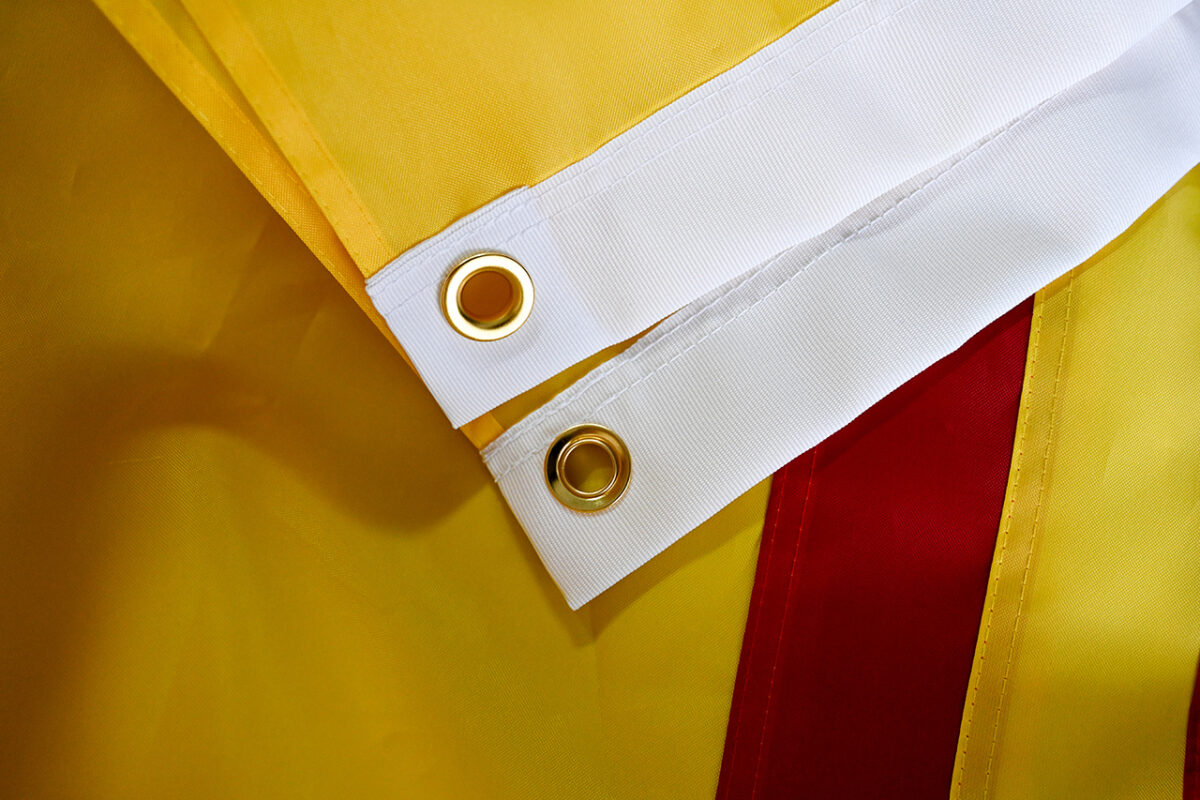
- Heading type. Canvas header with two brass grommets (most common for pole halyards), pole sleeve, or D-rings. State grommet material and placement.
- Stitching. Double-needle lockstitch on the hems, with a reinforced fly end and additional rows on the heading where the pole load sits.
- Seam integrity on the centre join. The red-white join is the first place a cheaply built flag shows weakness. Ask for a flat-felled or reinforced join.
- Edge finishing. Straight, evenly trimmed edges with no loose threads — especially important when the buyer is photographing the goods at handover.
For office and promotional buyers, hand-held flags, desk sets and small banners are usually ordered alongside the national flags. Keep those items on a separate line in the offer: a printed logo on a hand-held flag is normal commercial practice, but corporate branding should never be added to a national flag itself. If a client asks, propose separate event flags or banners instead.
Documentation and quality control for public buyers
Government and school procurement is audited. Your offer should carry the documents the evaluation committee needs to score it, and the delivery should carry the documents the receiving officer needs to sign it off.
- A technical specification sheet per item: fabric, weight, finished size, ratio, heading type, grommets, stitching, packing.
- A pre-production sample approved by the buyer in writing, plus the approved colour swatch retained for lot comparison.
- A stated inspection routine before shipment, with photo records of the packed cartons and carton markings.
- A packing list with carton dimensions, net and gross weight, and item counts per carton.
On compliance paperwork, be precise. Buyers sometimes ask for material declarations or test reports; ask the supplier to confirm what documentation genuinely exists for the specific fabric being quoted, and offer only that. Promising documents that cannot be produced later is a fast way to lose a repeat tender.
Packing, shipping and seasonal timing
Institutional Indonesian flags wholesale orders are usually distributed onward — one central purchase split across dozens of school sites or regional offices. Cartons should therefore be uniform, clearly marked with item code, size and quantity, and easy to re-count. Flat-folded packing keeps volume down and freight cost per unit lower; rolled packing protects large ceremonial flags but consumes more container space.
Timing matters more than most buyers expect. Demand clusters around the independence day period in August and around the start of the school year in July, and freight space tightens accordingly. Tender awards for those windows typically land weeks earlier, so plan production and sea freight backwards from the required delivery date and add buffer for port congestion. Consolidating flag orders with other textile items from the same supplier also improves the economics of a mixed container.
What to ask a supplier before you commit
When comparing quotes for bendera merah putih production, put these questions in writing:
- Can you produce both the sewn two-panel construction and printed variants, and advise which fits my specification?
- What is your sample lead time, and can the sample be produced on the exact fabric you are quoting?
- How do you control colour consistency between the approved swatch and the bulk run?
- What are your minimum order quantities per size and per fabric?
- Who handles the pre-shipment inspection, and what records will I receive?
Clear answers to those five questions tell you more about a factory than a price list. A supplier who pushes back on an unclear specification is usually protecting the buyer’s timeline, not obstructing the order.
Building an offer that survives evaluation
Tender success in this category comes from a disciplined specification, a fabric matched to the actual use, finishing that matches the promise, and documentation that lets the buyer defend the award. Price is part of the equation, but only after those four are settled. Buyers who source Indonesian flags wholesale repeatedly tend to consolidate with one Indonesia flag supplier who can hold the same standard across lots and sizes — and who responds in writing when the annex is ambiguous.
If you are preparing a bid for a government, school or office tender and need specification sheets, size options and packing details to attach to your offer, browse the flag and textile range on flagpartner.com and send us the tender annex — we will quote against your exact requirements.
Browse the full range: https://flagpartner.com/shop/
Email: flagswin@flag-win.vip
WhatsApp: +86 13031678795
Facebook: https://www.facebook.com/StarFlagFactory/
Alibaba.com: https://wfqyflag.en.alibaba.com/